
How to Find the Correct Trailer Wheel Bearings
Choosing the correct trailer wheel bearings is critical for safety, reliability, and long-term performance. Whether you’re servicing a box trailer, boat trailer, caravan, or camper, using the wrong bearings can lead to overheating, rapid wear, or even wheel failure.
This guide explains:
-
How to identify your trailer bearings correctly
-
How to read bearing numbers
-
The difference between bearing cone vs cup
-
Common bearing configurations used on Australian trailers
Why Correct Trailer Bearings Matter
Trailer wheel bearings:
-
Carry the full load of your trailer
-
Allow smooth wheel rotation
-
Prevent heat build-up in hubs
Incorrect or worn bearings can cause:
-
Excessive heat
-
Wheel wobble or noise
-
Hub, spindle, or axle damage
Correct identification is essential.
The Most Accurate Method: Remove & Read the Bearing Numbers
The only guaranteed way to identify trailer bearings is to physically remove them and read the stamped numbers.
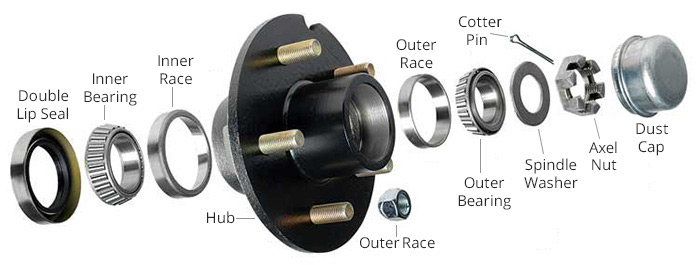
What You’ll Need
-
Jack & wheel brace
-
Pliers or screwdriver (for grease cap)
-
Rag or paper towel
Step 1: Remove the Wheel & Hub
-
Jack up the trailer and remove the wheel
-
Pry off the grease cap
-
Remove split pin and castle nut
-
Slide the hub off the axle
You’ll now see:
-
Outer bearing
-
Inner bearing
-
Seal (pressed into the hub)
Step 2: Locate the Bearing Numbers
-
The bearing number is usually stamped on the cone (roller bearing)
-
Clean grease off if needed
-
Write the number down exactly as shown
Common examples:
-
LM68149/10 -
25580/20 -
30210J
How to Read Trailer Bearing Numbers
Bearing numbers identify the exact size and type of bearing — not just the brand.


Example Explained: LM68149/10
-
LM68149 = Bearing cone (roller bearing)
-
/10 = Matching cup (race)
These two parts form a matched set and must always be replaced together.
Why the Suffix Matters
Suffixes like:
-
/10 -
/11 -
/20 -
/245
Indicate differences in the bearing cup (width, chamfer, or standard).
⚠️ 68149/10 and 68149/11 are not interchangeable.
Visual Guide: Bearing Cone vs Bearing Cup (Race)
A trailer wheel bearing consists of two matching parts.

Bearing Cone
-
Contains the rollers
-
Slides onto the axle
-
Usually has the bearing number stamped on it
Bearing Cup (Race)
-
Smooth outer ring
-
Pressed into the hub
-
Does not rotate
👉 Bearings must always be replaced as a cone + cup pair.
Common Trailer Bearing Configurations (Australia)
The table below shows commonly used bearing combinations found on Australian trailers, including setups used by manufacturers such as AL-KO, Dexter, Trojan, and Vehicle Components.
⚠️ This table is a reference only. Always confirm bearing numbers physically.
Bearing Configuration Table
| Configuration | Inner Bearing | Outer Bearing |
|---|---|---|
| LM 0.75t – Holden | 67048/10 | 11949/10 |
| SL 1.45t – Ford / Slimline | 68149/10 | 12749/10 |
| PLL 1.6t – Parallel | 68149/10 | 68149/10 |
| AU 2.25t – AL-KO 2T | 30210J | 15123/245 |
| AU 3.0t – AL-KO 3T | 30210J | 29749/10 |
| DEX 3500LB – Dexter 3500 lb | 68149/11 | 44649/10 |
| DEX 6000LB – Dexter 6000 lb | 25580/20 | 15123/245 |
Important Notes on Common Configurations
Parallel Bearings
-
Same bearing inner and outer
-
Common on 45 mm square axles
-
Often paired with 6-stud hubs
-
❗ Not the same as Ford bearings
AL-KO 2T & 3T Bearings
-
Found on genuine AL-KO braked axles
-
Larger taper roller bearings
-
Inner and outer bearings are different sizes
-
Correct seal selection is critical
Dexter Bearings
-
Common on imported or US-style axles
-
Often mistaken for standard sets
-
Not interchangeable with Ford or Holden
Don’t Forget the Seal
Replacing bearings without replacing the seal is a common mistake.
Always identify:
-
Seal inner diameter
-
Seal outer diameter
-
Seal width
A worn seal can allow grease loss and water ingress, destroying new bearings.
Boat Trailer Tip 🌊
Boat trailers face:
-
Water exposure
-
Salt corrosion
-
Frequent submersion
If bearings show rust, pitting, or blue heat marks — replace them immediately and use marine-grade grease.
Final Checklist Before Ordering
Before purchasing bearings, confirm:
✅ Inner bearing number
✅ Outer bearing number
✅ Matching cup numbers
✅ Seal size
✅ Braked or unbraked hub
Final Word
Trailer bearing identification should never be a guess. Bearing numbers stamped on the bearing itself are the only reliable method — not trailer size, axle rating, or stud pattern.
When in doubt:
-
Remove the bearing
-
Read the number
-
Confirm before ordering
It’s the safest and cheapest way to keep your trailer rolling reliably.